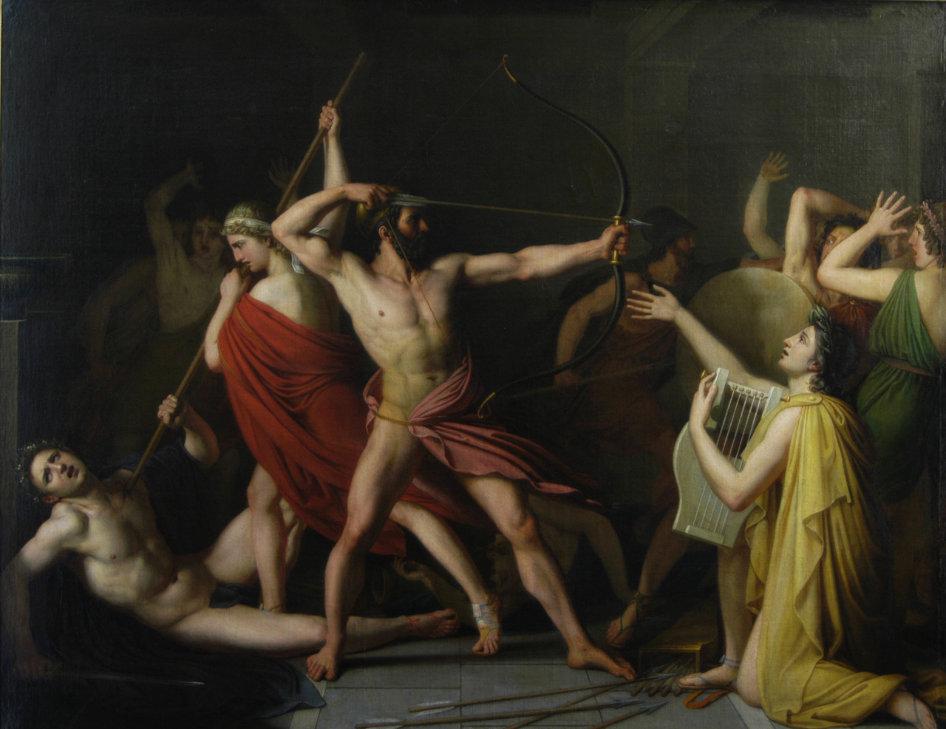
Ulysses and Telemachus kill Penelope's Suitors by Thomas Degeorge (1812)
“From the middle of life onward, only he remains vitally alive who is ready to die with life.”
Carl Jung
I don’t mean to mythologise my midlife crisis.
That’s not my intention with these letters. I’m just a guy — quite a lucky and privileged one, really — and there’s nothing historical or unprecedented about the year I’ve had. I know some of you are enduring far greater heartbreak, uncertainty and hardship in your lives at this moment.
My intention is the inverse: it’s to make the point that the purpose of myth is precisely to help us navigate these major crises, these moments of spiritual pain and growth in our lives. That’s why those stories were first told, why their ancient image symbols come pre-loaded in our collective unconscious.
There are still some wild parts of this story to tell you about and some big announcements about my life — but don’t worry, if this miniseries isn’t doing it for you, I’ll be changing it up next month.
So, onwards!
This is the fifth instalment in a very personal series of letters about a period of transformation and growth in my life.
You can read the rest of the letters here.
Here’s a funny story about my broken heart.
C, (whom I had recently separated from), is an actor; and not long after our break-up, she appeared in one of the biggest TV shows of this year. I won’t tell you which one to spare her privacy, but you’ve heard of it and probably even watched it.
Well — spoiler — C’s character dies in this show, in a scene laden with mythological energy. I knew she was going to die: we were still together when she filmed for it and I remember her complaining about spending a long day lying face-down in mud.
And yet: watching her die on screen did a real number on my subconscious and triggered a wave of grief that had me flat on my back for several weeks. Up until that point, I was able to comprehend our break-up intellectually, but I hadn’t begun processing it emotionally. In some ways, it felt like we were still together.
Well, the indelible image of her lifeless body, face-down in the dirt, put paid to that.
Suddenly the profundity of our separation came crashing through me, in 4K at 30 frames-per-second. C was dead, her presence in my life gone; I finally had to accept that our relationship had died as well.
This, folks, is why we don’t date actors.
✹
In The Hero With A Thousand Faces, Joseph Campbell’s first stop for the adventurer who has dared cross the threshold into an unknown world, he calls The Belly Of the Whale:
“The idea that the passage of the magical threshold is a transit into a sphere of rebirth is symbolised in the worldwide womb image of the belly of the whale. The hero…is swallowed into the unknown and would appear to have died.”
Joseph Campbell
Mythological characters appear to die frequently — often to come back to life, the most notable example here in the West being Christ.
This trope, Campbell argues, is meant to pass a vital piece of wisdom down to us, and it is this:
Every major crisis or loss in our lives — a breakup, a bereavement, a divorce, a job-loss or a health scare — are deaths: spiritual ones, but deaths all the same. Our material selves often come out unscathed, but parts of our egos, our inner worlds, perish.
This is good! Any time our egos take a bullet, we have a chance to glimpse our true selves beneath.
The mythologist Michael Meade adds that life is necessarily a sequence of these mini-deaths and that each spiritual death is the precondition for a spiritual rebirth. It’s through these death-rebirth cycles that we each grow and mature. It’s how we live.
Now then, here are a few images that capture the moment of death/rebirth in our popular culture (plus a panel from one of my own comics — I couldn’t resist, look at the similarity! I did not do this on purpose).


L-R: A panel from V For Vendetta, an iconic shot of The Shawshank Redemption, a panel from a short story by me and Christ Crucified by Diego Velaquez
I contend that this posture — arms stretched in surrender — is embedded in our collective image system to state an essential truth: in order to be reborn, you must die and in order to die, you must submit to it.
But can you face death? Are you willing to surrender your being and be utterly annihilated?
Many people — most people? — cannot. They turn back, preferring to shrink than to face oblivion.
My breakup up was just one of several mini-deaths I have experienced in this year of profound transformation. I promise you that the moment of complete submission is utterly exquisite, a moment of complete aliveness, even as a part of you “dies”. When an opportunity like this comes your way, try to face it if you can, arms out-stretched and let it wash over you.
I’m grateful to my friend Rishi who sent me this admonition from the philosopher Nietzsche, right when I needed it. It’s been a touchstone for me this year:
“You lack the courage to be consumed by flames and to become ashes; and so you will never become new and never young again!”
Friedrich Nietzche
✹
It was several months before I saw C again. We met in a London park on a humid midsummer’s day. In her presence once more, I found myself overwhelmed with emotion.
After all, the last time I saw her, she was dead.
And now here she was, smoking a cigarette in the summer sun, reborn.
Until another Sunday soon,