First, I’m sure you want to hear the song!
No A.I. was involved in the making of this song.
It’s nice isn’t it?
How did I get from “no musical experience” to a finished song in just a few weeks?
This was going to be a short description but it has developed into a full step-by-step rundown, with music samples and footnotes…Strap in!
It started with a birthday gift to myself: a Roland FP30X digital piano. I’ve lusted after one of these for years and, staring down the barrel of a long winter of solitude, I needed something to keep my hands occupied.
What is my musical ability? I would say limited. I know the notes on a piano and I can punch out a chord pretty reliably. I can sightread musical notation, although keys and modes mystify me. As you’ll hear, my piano playing is passable, certainly not masterful.
What I do have is several decades of intense and diverse listening behind me and for years I have used sites like Chordify to learn the chords of songs I like. This has been a useful (and cheap) musical education: I have discovered chord patterns that evoke certain feelings in me and I’m learning to recognise them as I listen and play.1
How the song came together
I’ve written before about the power of noodling in the creating process, and music might be the most noodle-friendly art form there is — for two related reasons.
Firstly the feedback loop is instantaneous — you don’t have to wait for anything to load/export/refresh to hear what a note sounds like; and secondly, mistakes vanish equally quickly — if you play a duff chord, you don’t have to press backspace, Ctrl Z or get out an eraser, the offending sound vanishes the second your fingers lift off the keys.
For these reasons, my hands seem to explore the keyboard with a freedom they cannot find in a sketchbook.
Composing
This song began with a noodle.
At the tail end of January I was trying solve an unrelated problem (probably to do with this website). Needing a mental break, I turned 90 degrees to my left, where my piano sat idly, invitingly. Without thinking, I played the most obvious chord there is: C Major and without thinking, I hit the most obvious chord to play after that (because it’s the next natural chord along): D Major. I played them in one of the upper octaves because it was the part of the piano closest to my desk.
Here’s what that sounded like.
Now to my ear, those two chords just bouncing off of each other sound very lovely and innocent, there is something sweet or delicate, even pastoral about them2.
I moved down the piano, curious to hear how these two chords would sound played whole and in a lower octave. Also, rather nice:
I stopped playing and went back to work. And this is when the magic happened, when the Mystery decided to become involved.
At some point — I think it was a few days later — a complete melody came into my head, whole cloth. I swear to God, it just dropped into my grey matter and wouldn’t leave: a gift.
I thought to myself, half-jokingly: “If I can figure out how to play this melody, I might have a song.”
I don’t know how to write melodies or figure out what notes are in a certain key, so I figured this out the slow way: guessing.
It made sense that the first note(s) would be from the triad that make up the C Major chord: C, E and G. The first two sounded right, but the G just sounded too low. So I tried the next note up Ab: that sounded bad. So up again: A sounded right.
Like one of those safe-crackers that runs through lots of permutations, I unlocked the melody this way, one note at a time. After about 30 minutes, I had this:
This sounds nice, but it’s hardly a whole song. So I thought about how to develop it and one obvious way is to change the key. After a ‘verse’ of bouncing between C Major and D Major, I changed the chords up a few steps to Eb Major and F Major. I needed to transpose the melody as well, which is simple enough on a piano.
And then I thought “what the hell!” and moved the chords up again for a third verse: to Gb Major and Ab Major. An unexpected side-effect of this is that in this key, melody notes only use the black keys – I could hit any black key and it would sound great. So I found myself experimenting with the melody and getting a little jazzy here.
Recording
I made Naturally, Dear Naturally in GarageBand because it’s free and already on my laptop. The song does not have percussion because I do not know how to create drum loops.
And because I also can’t play the piano ambidextrously (with one hand playing chords and the other playing the melody) — yet! — I recorded these parts separately and arranged them together. I used the built-in Grand Piano sound and didn’t even adjust it. Playing live into GarageBand took some getting used to: it took multiple takes of each part to keep to the tempo.
But after a couple of sessions I had all the main parts down.
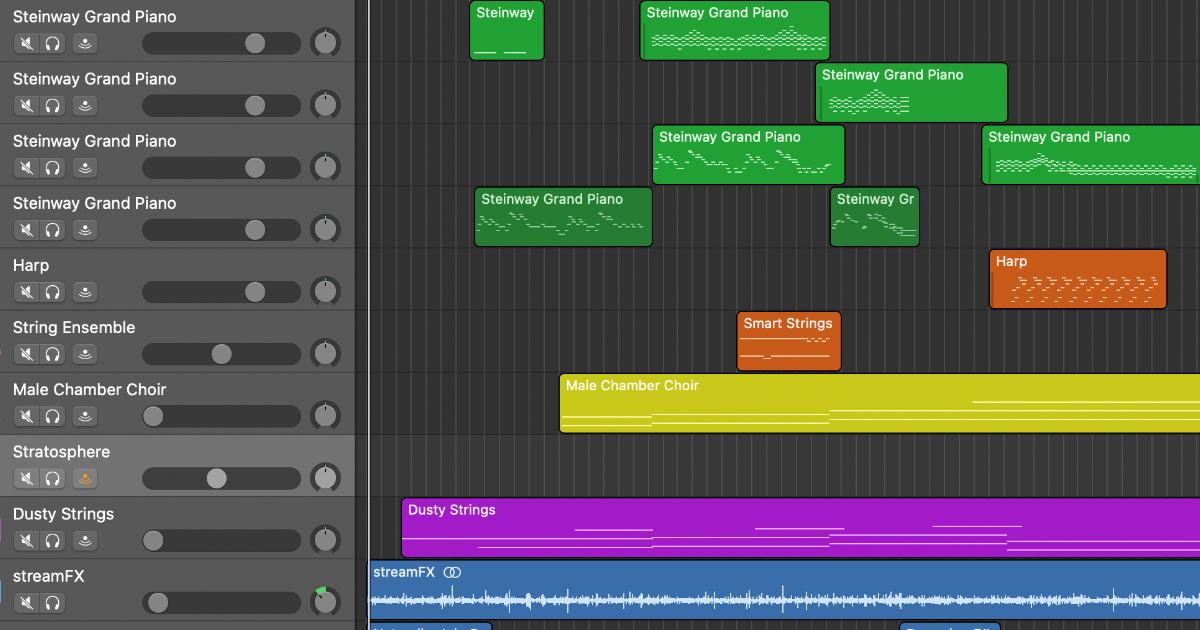
Listening to music for years, I’ve noticed that layering in textural chords does a lot to add atmosphere and depth to a sound. So I played basic synth chords in the second note of each pattern (so D Major, F Major and Ab Major) because that sounded better than playing the first note.
The song that was emerging generated a very lovely pastoral image in my mind: of a lazy walk through a meadow on a sunny summer afternoon. As I played the song back, I kept hearing the gentle wash of a river or a stream in my head. Environmental sounds like this appear in the ambient and downtempo music3 I listen to most, so it felt very natural to add some to my song.
And finally, there are the words of the English mystic John Butler, which give the song its title. The story of John and his impact on my life will have to wait for another day, but a video of him speaking of simple pleasures by a river on a blissful English summer afternoon found its way to me the week I was finishing the track: another gift it would have been rude to turn down.
I find songs where words are said and not sung very powerful. The lyrics, plain spoken, contrast with beautiful harmonies into something both poetic and sensual. If you want to explore this genre, I have a playlist called Talking Songs.
Should it be this easy?
How did I go from having almost no musical experience to recording my first song? Well I’d be remiss if I didn’t conclude it all happened, well… ‘Naturally, Dear Naturally’.
This is not for a second to suggest making music is easy, or even that what I have made meets any kind of musical standard. I’m sure that if I laboured harder and studied more perhaps the song could be more complex, who knows.
What I do know is that inspiration handed me a complete melody and asked that I finish the work. It is one of the most clear moments of fully formed inspiration I have ever experienced. I’m proud that I honoured the gift and finished the job.
You might wonder, if the universe really wanted this song to be out in the world, why give it to a man with a new piano he barely knows how to play? Why not hand the melody to Bad Bunny or Taylor Swift (or one of their many writers)?
I can’t think of a good reason, except to make the point — through me — that music belongs to everyone.
It’s quite thrilling to discover that tracks as diverse as Olsen by Boards of Canada, Zero 7’s Destiny, Wedding Song by Anais Mitchell, right up to Hey Now by London Grammar, even the theme song to Countdown all fundamentally use
C,EbandF. These chords sound so nice together, in any order. ↩︎Any chords the same distance apart will sound like this, try
FandG,AandB,BandDbandEandF#for example. ↩︎Try the opening to La Femme D’Argent by Air or Hallaig by Martyn Bennett. ↩︎